Reproductive Justice Workshop with Renowned Scholar Khiara Bridges
19 January 2026
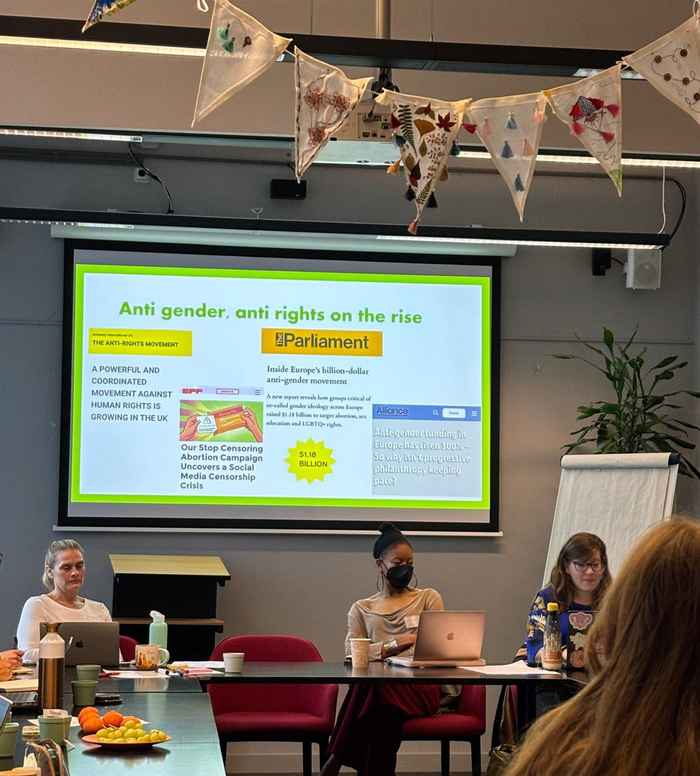
The workshop brought together a wide variety of participants from different fields: health researchers and students from UvA, VU, Utrecht University, Wageningen University and Erasmus MC; abortion activists from SAFE; doulas and abortion care consultants; and consultants from Share-Net, KIT, Rutgers and FIOM.
Thought-provoking presentations
The workshop was kickstarted by four thought-provoking six-minute presentations, titled ‘pitches and provocations’. Nicole Moran from Share-Net and KIT spoke about how academia often fails to recognize hierarchies, often resulting in a situation where those who give their voices and experiences to research do not reap the benefits. Next, Mara Clarke, an abortion activist and the founder of Supporting Abortions for everyone (SAFE), spoke about abortion activism as reproductive justice. She encouraged academics to join forces with activists, but urged them to budget for and respect activists’ time, and to not be offended if activists don’t prioritise working with them, given all the urgent demands on their time. Researchers and doulas Syllona Kanu and Etiennette Coster then presented their research about how stereotypes of racialised women influenced decision-making in obstetric care in Dutch hospitals. In the high-pressure environment of a hospital, racial stereotypes are used by medical professionals as shortcuts, with harmful consequences for, for instance, decisions about pain relief. Finally, Professor Khiara Bridges discussed the assault against universities by the Trump administration, with the intention of penalising academics for involvement in activism. As this is done through administrative decision-making rather than lawsuits, these measures are effectively ‘outside the law’. She also noted that it is becoming easier to do reproductive justice work while also doing research these days: and this can lead to real action.
Concrete suggestions for more impact
In the second half of the workshop, attendees broke into smaller groups and discussed the provocations that the speakers pitched earlier in the day. After some engaged discussions, we came back together as a group to share our ideas and suggestions for future work and engagement. Overwhelmingly, attendees noted that it often feels like across academia and in NGOs/ activist networks we are fighting fires instead of finding the space to advance the cause of reproductive justice due to ongoing funding cuts across increasingly fascist regimes in the global north.
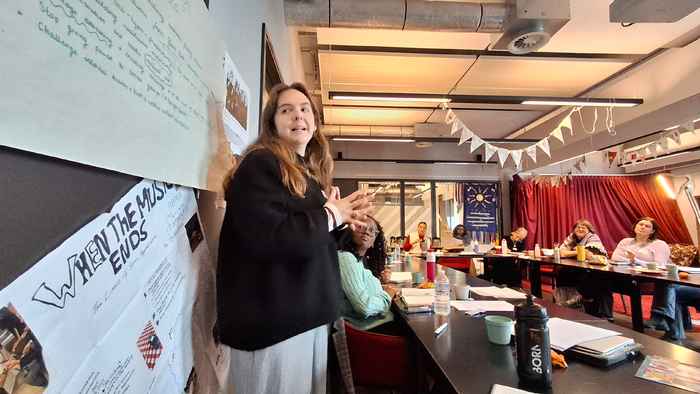
Concrete suggestions were also made to help make our work more impactful:
- Engaging in feminist knowledge management as a way of bridging the hierarchical gap in academia.
- Pushing for all academic publications to be open-access so that they can be utilized outside of academia.
- Creating knowledge products that are useful to our audiences rather than the default academic paper. For example, see Share-Net’s guide ‘Knowledge Brokering for Feminist Futures’.
- Researchers need to put our money where our mouths are: donate to your local abortion fund or other funds/organizations that forward the cause of reproductive justice. For more information, visit: www.supportingabortions.eu
- Support doulas, who play a crucial role in improving the birth experiences of women of colour by listening and holding space during the birth.
Connection and inspiration
Overall, the workshop left all attendees feeling connected, inspired and informed. Many attendees noted a desire to make this a semi-annual event so that we can continue to build bridges between academia, activism and maternal health care and further the aims of reproductive justice in Europe and across the world.